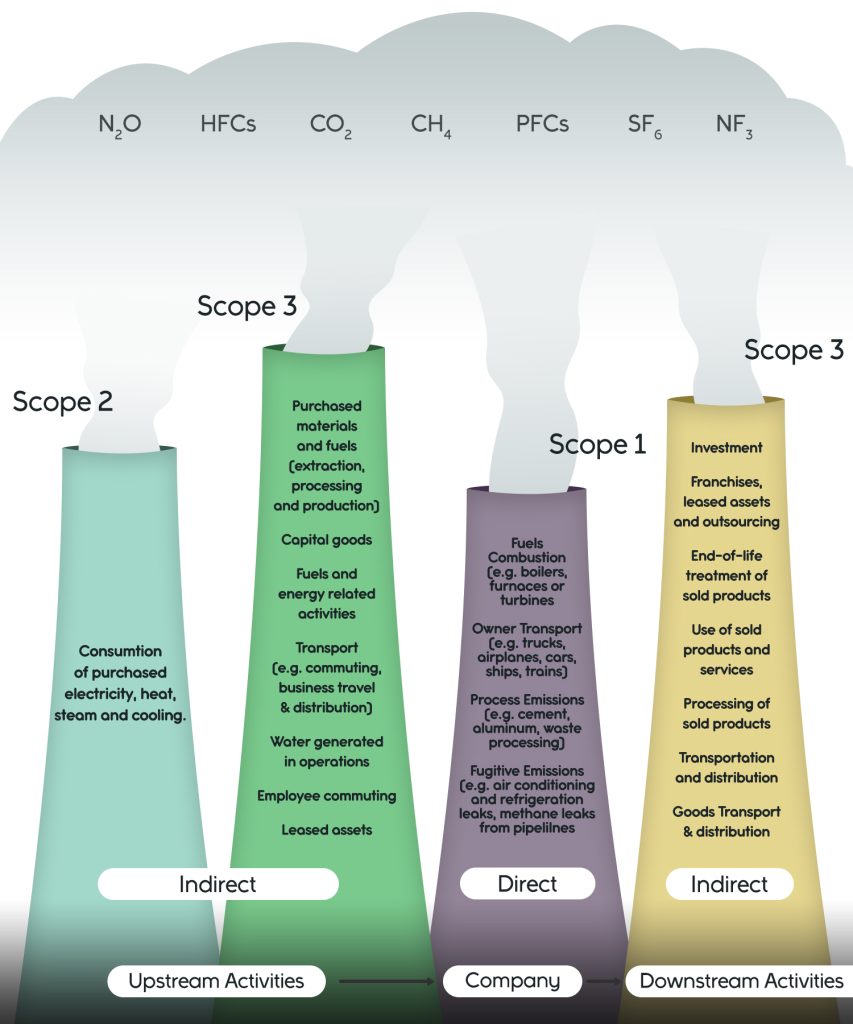
Emission Scopes
The Climate Manager says, “Let us now try to understand what the emission sources are, categorize them and see how each one can be managed. Simply put, emissions are categorized either as direct or indirect. They can also be subclassified as,
- Types of emission falling under any of the seven GHG gases.
- Emission by assets or source that use fuels to operate.
- Geographical location of the emission source
- Time when the emissions are measured.”
“Under the internationally defined GHG accounting guidelines emissions are grouped in a way that two or more companies do not account for the same emissions.”
“Scope 1: These emissions occur directly from sources that a company owns or controls. For example, direct use of fuels in vehicles, boilers and furnaces. Also, emissions from production in owned or controlled process equipment. Here the emissions are generated at the location where consumption takes place.”
“Scope 2: This is an indirect emission generated from the purchased electricity consumed by the company for use in its facilities. Here the emissions occur outside the boundaries. Examples: purchased electricity from power plants to support manufacturing equipment, lighting and other needs of Company owned and operated assets.”
“Scope 3: This is for the treatment of all other indirect emissions. These emissions are due to supporting activities not owned or controlled by the company. Examples: purchased goods and services, business travel and employee commuting, transportation of products to customers, manufacturing waste, etc.”
“In simple terms:
- Scope 1 are direct emissions from sources owned or controlled by the company.
- Scope 2 are indirect emissions from use of grid-supplied electricity, heat, steam or cooling.
- Scope 3 are indirect emissions associated with the company’s value chain.”
“There are sources and facilities whose emission information is still incomplete. Uncertainties so associated with them are categorized as;”
Scientific uncertainty arises when the science of the actual emission process is not completely understood. (“GHG Protocol guidance on uncertainty assessment in GHG inventories and …”).
Estimation uncertainty arises where data are not specific from different regions, sectors and activities. It becomes tricky to apply values as the result accuracy is not guaranteed.
“It is a matter of working backward to study and observe factors of emissions and identify the areas of efficiencies, reductions and offsetting emissions.”